Networking Protocol Suites
By Stephen Bucaro
Network protocols define rules for handling data and communicating in a particular
networking environment. Individual protocols operate at specific layers in the OSI
reference model. A protocol suite is a group of protocols designed to work together.
The three major protocol suites are NetBEUI, IPX/SPX and TCP/IP.
NetBEUI
IBM designed NetBIOS (Network Basic Input/Output System) for small workgroups that
did not have a central server. NetBIOS establishes a communication session between
computers. NetBEUI (NetBIOS Extended User Interface) is an enhancement of NetBIOS to
provide the data transport services. NetBEUI was developed as part of IBM's LAN
Manager network operating system.
Later, Microsoft used the NetBEUI protocol in Windows For Workgroups (Windows 3.11)
to provide peer-to-peer networking ability. NetBEUI is used today to support
networking on the Windows 9x and Windows NT operating systems. NetBEUI is a simple,
fast protocol. It was not designed to communicate from one network to another, so it
is not routable. It operates only at the transport and Network layers of the OSI model.
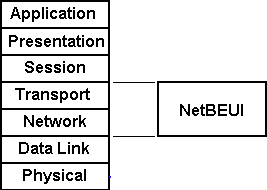
In a Microsoft Windows network operating system, you assign a NetBEUI name to
each computer. This is the name you see in the Network Neighborhood directory
listing. The name must adhere to the NetBEUI naming convention; it must be unique
with a maximum of 15 characters with no spaces. The NetBEUI protocol addressing
scheme assigns a one-character suffix to the computer's name to differentiate between
the specific services or functions provided by the computer.
IPX/SPX
Internetwork Packet Exchange/Sequenced Packet Exchange (IPX/SPX) is a protocol
used by Novel's Netware product. IPX/SPX is based on the XNS/SPP (Xerox Network
Systems/Sequenced Packet Protocol) designed by Xerox. IPX/SPX is composed of two
main parts. One part is connectionless; the other part is connection based.
SPX is a connection oriented protocol. Connection-oriented protocols require a
node to return an acknowledgement when a packet arrives and resending of the packet
if an error occurs. This method provides reliability, but sending acknowledgements
makes the transmission slower.
IPX is a connectionless protocol. Connectionless protocols don't require acknowledgements.
When broadcasting a message to all nodes you usually do not want acknowledgements
returned because this would increase the network traffic unnecessarily. Connectionless
protocols operate faster.
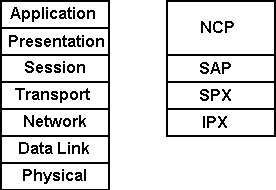
IPX/SPX provides protocols for operating at the OSI network layer through to the
application layer. At the network layer the IPX protocol handles the routing of data
packets between networks. At the transport layer SPX handles the process of breaking
data into smaller chunks on the sending end and reassembling them on the receiving
end. Server Announcement Protocol (SAP) provides the session layer task of creating
and maintaining connections. NetWare Core Protocol (NCP) handles the tasks of the
presentation and application layers.
There are two types of addressing schemes. Physical addressing refers to
the MAC address built into every NIC, this cannot be changed. Logical
addressing refers to an address that is assigned or configured and can be changed.
Of course in the end the logical address must be translated to the MAC address.
| 

 About BTH
 User Agreement
 Privacy
 Site Map
 Contact
 News Feeds


 RSS Feed
 Follow @Stephen Bucaro
 Basics and Certification


