The OSI Network Layer
By Stephen Bucaro
If you have a very large network, you may divide the network into several segments
and assign a network address to each segment. The Network layer, layer three of the
OSI model, adds a source node address and a destination node address to each data packet.
The Network layer uses logical addressing. Routable protocols at the Network layer deliver
data packets to networks connected through routers.

Whereas the Data Link Layer (Layer 2) of the OSI model works with "frames", the
Network Layer works with "packets". Routing protocols reside at the Network layer.
Everything about routing is handled at the Network layer. The Network layer protocol
adds a source node address and a destination node address to each data packet. Each
LAN or network segment has a unique logical address.
Internet Control Message Protocol (ICMP)
ICMP is a Network layer protocol that reports on the success or failure of data delivery.
It detects error conditions such as "Network unreachable" or "Access denied". It can
indicate when part of a network is congested, when data fails to reach its destination,
or when data has been discarded because the allotted time for its delivery (TTL) has expired.
ICMP anounces transmisssion failures to the sender, but ICMP cannot correct any of the
errors it detects. The ICMP announcements provide information to upper-layer protocols so
that they can route packets around problem areas.
Router
Routing is the process of moving data packets from one network or network segment to
another. A packet that has a destination not on the local subnet is sent to a node called
a default gateway that can communicate outside the local subnet.

A router uses a routing table to determine which router is conected to the network
that has the computer with the destination address. Routing protocols such as OSPF (Open
Shortest Path First) Network layer are used to update the routing table.
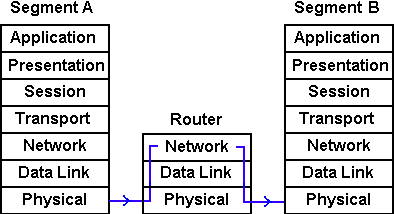
Routing uses the Network layer of the OSI model to direct data packets to the proper network or subnetwork.
More Networking Protocols and Standards:
• IPv4 to IPv6 Transition With the Dual-Stack Technique
• The TCP/IP protocol Datagram Format
• Networking Routing Believability and Administrative Distance
• IP Addressing
• The OSI Application Layer
• What Are Private IP Addresses?
• Evolution of the Microsoft NOS (Active Directory)
• Integration of IPv6 with IPv4
• Session Border Controllers - More Than Just a Voice Firewall
• What Is Fabric Networking?
| 

 About BTH
 User Agreement
 Privacy
 Site Map
 Contact
 News Feeds


 RSS Feed
 Follow @Stephen Bucaro
 Basics and Certification


