IP Addressing
By Stephen Bucaro
Internet Protocol (IP) is a Network layer protocol used to route packets across
networks. The IP protocol uses a 32-bit address to define the network segment
address and the node address. If the device is to be connected to the Internet, the
address needs to be unique among all other devices connected to the Internet. You can
ensure that your IP address is unique by obtaining an address from the Internet
Network Information Center (InterNIC). For networks, InterNIC assigns blocks of addresses.
An 8-bit binary number can be written as a decimal number between 0 and 255. An IP
address is usually written as four 8-bit decimal numbers that are separated by dots.
The numbers 0 and 255 are reserved for special purposes. A "subnet mask" is used to
determine which part of the IP address is the network address and which part is the
node address. The right side part of the number is the node identifier. The more digits
used for the node identifier part of the number, the more hosts you can assign to the network.
Address Classes
InterNIC assigns blocks of addresses defined by classes. Class A networks use the
right three parts of the address for host identifiers. This allows the assignment of
16,77,214 unique host identifiers. This leaves the left part of the address for
network identifiers. The first bit of the leftmost part of the IP address is used to
identify the class type. This leaves seven bits for network identifiers, allowing for
126 unique network identifiers.
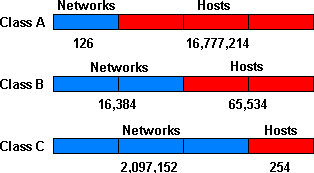
Class B networks use the right two parts of the address for host identifiers. Class
C networks use the right one parts of the address for host identifiers. Using a
network class with less parts for host identifiers leaves more parts for network
identifiers. Below is a chart of the number of networks and hosts supported by the
different network classes.
| Class | First Bits | Number of Networks | Number of Hosts |
| A | 0 | 126 | 16,777,214 |
| B | 10 | 16,384 | 65,534 |
| C | 110 | 2,097,152 | 254 |
Subnet Mask
Routers use the class identifier bits to determine which parts of the IP address is
the network address and which part is the host address. For example, if the first bit
in the IP address is 0, the router will create a subnet mask with the pattern 255.0.0.0.
Using the logical AND operation with the IP address and the subnet mask causes
the last four parts to be masked, preserving only the network address.
Note: Some study materials refer to the parts of the IP address as
digits, bits, or bytes. When answering exam questions be sure to note how the
questioner is referring to the number. Each dot-separated section of the IP address
can contain one, two, or three digits. A byte can be represented as one hexadecimal
symbol or eight digital bits. Many texts contain errors in describing IP address
classes.
An organization is not locked-in to the number of networks and hosts provided by
the network class they are assigned. The network engineer can create custom subnet
masks to increase the number of unique network addresses, or he can use a proxy
server. Using a proxy server, every host on the network does not need a unique
Internet IP address. Only the proxy server is provided with a unique Internet IP
address. User requests to the Internet are intercepted and handled by the proxy server.
Because only the proxy server's IP address is visible to the Internet, internal network
and host addresses only need to be unique internally.
When using Web browsers, humans find it difficult to use and remember IP addresses.
For this reason a system was created to permit the use of names as aliases for the IP
addresses. To actually route the requests to the proper host, routers need the IP
address in number form. The Domain Name Service (DNS) provides a method of resolving
the aliases to IP addresses. DNS servers contain an index of aliases and their related
IP addresses. If a DNS server cannot resolve a name, it can query another DNS server
that can resolve it.
| 

 About BTH
 User Agreement
 Privacy
 Site Map
 Contact
 News Feeds


 RSS Feed
 Follow @Stephen Bucaro
 Basics and Certification


