System Area Network Interface Cards
By Stephen Bucaro
In organizations with large critical mission networks, servers are arranged in
clusters. In a cluster servers are configured to share resources such as
storage and processing as if they were a single more powerful server. If a
server in a cluster fails, the other servers in the cluster take over for it
and continue processing (called "fail-over").
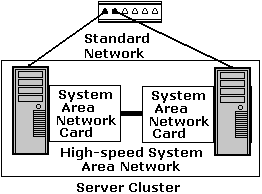
Servers in a cluster can be configured to communicate with each other the
standard network, but in order to achieve the high level of performance
required, they usually communicate with each other directly over a separate
higher speed and higher reliability System Area Network.
Whereas the standard network may use twisted-pair cabling, the System Area
Network may use separate fiber-optic cabling. System Area Network
interface cards are special high speed circuits that provide communications
between the servers over the System Area Network.
If there are only two servers in a cluster, their System Area Network Interface
Cards can be connected directly to each other by a cable. If there are more
than two servers, a special hub is used to provide the connection.
More Networking Topologies Articles:
• Understanding Optical Fiber Types
• Computer Network Routers, Hubs, and Switches
• How to Choose the Proper Fiber Optic Connector for Your FTTH (Fiber To The Home) Installation
• Wireless Networking Infrastructure Mode
• Cisco Switching Fundamentals
• Distance Vector vs. Link State vs. Hybrid Routing
• Network Storage Server Options
• Fiber Media Converter - What's the Use and How to Choose It
• Difference Between Unmanaged, Web Smart and Managed Switch
• How to Set up a Private Network
| 

 About BTH
 User Agreement
 Privacy
 Site Map
 Contact
 News Feeds


 RSS Feed
 Follow @Stephen Bucaro
 Basics and Certification


