Java Script provides three different types of message boxes that allow you to display a short message to the user, or request a bit of information from the user. If one of these built-in message boxes don't suit your needs, this article shows you how to create your own custom message box.
Welcome to Bucaro TecHelp!

Welcome to Bucaro TecHelp!
Maintain Your Computer and Use it More Effectively
to Design a Web Site and Make Money on the Web

About Bucaro TecHelp About BTH User Agreement User Agreement Privacy Policy Privacy Site Map Site Map Contact Bucaro TecHelp Contact Advertise on Bucaro TecHelp Advertise Here RSS News Feeds News Feeds

HTML5 Solutions: Essential Techniques for HTML5 Developers

Essential Techniques for HTML5 Developers

HTML5 brings the biggest changes to HTML in years. Web designers now have new techniques, from displaying video and audio natively in HTML, to creating realtime graphics on a web page without a plugin.

This book provides a collection of solutions to all of the most common HTML5 problems. Every solution contains sample code that is production-ready and can be applied to any project.

Click Here

Java Script Message Boxes

In Java Script programming, there are many occasions when you need to display a short message to the user, or request a bit of information from the user. In these instances, you can use a message box.

Java Script provides three types of message boxes, the alert, confirm, and prompt. They are all easy to create and use.

-  These message boxes are "modal" dialog boxes, meaning that program flow halts while the message box is visible. The user is unable to use the page that spawned the message box until they click on a button to close the message box. This may be disruptive to the user. Later in this article, I show you how to design your own custom message box, which you may or may not choose to make modal.
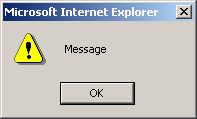
Alert message box

An alert presents a message with a single [OK] button to dismiss the message box. Example code to create an alert message box is shown below.

alert("Message");

Instead of a text string for the message, you could use a variable name. The alert function will automatically convert the value in the variable for display, making the alert a handy tool for script debugging.
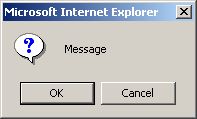
Confirm message box

A confirm presents a message with an [OK] button and a [Cancel] button. If the user clicks on the [OK] button, the confirm dialog box returns true. If the user clicks on the [Cancel] button, the confirm dialog box returns false. Clicking on either button dismisses the dialog box. Example code to create a confirm message box is shown below.

if(confirm("Message"))
{
  alert("User clicked [OK] button");
}
else
{
  alert("User clicked [Cancel] button");
}

A confirm message box can be used to ask the user if a certain function should be performed.

if(confirm("Perform function?"))
{
  // Code to perform function
}

RSS Feed RSS Feed


Web Design Sections

Eloquent JavaScript: A Modern Introduction to Programming

Eloquent JavaScript

Eloquent JavaScript Eloquent JavaScript goes beyond the cut-and-paste scripts of the recipe books and teaches you to write code that's elegant and effective. You'll start with the basics of programming, and learn to use variables, control structures, functions, and data structures. Then you'll dive into the real JavaScript artistry: higher-order functions, closures, and object-oriented programming.

Reader Anthony says, "This book is not your typical Javascript book. Others have a utilitarian approach. In stark contrast, Eloquent JavaScript does not merely provide you a checklist of things to learn but rather paints a panorama of the possibilities that programming provides. Javascript is merely the tool used to introduce these to the reader.

Click here for more information.


[Site User Agreement] [Advertise on This site] [Search This Site] [Contact Form]
Copyright©2001-2011 Bucaro TecHelp 13771 N Fountain Hills Blvd Suite 114-248 Fountain Hills, AZ 85268